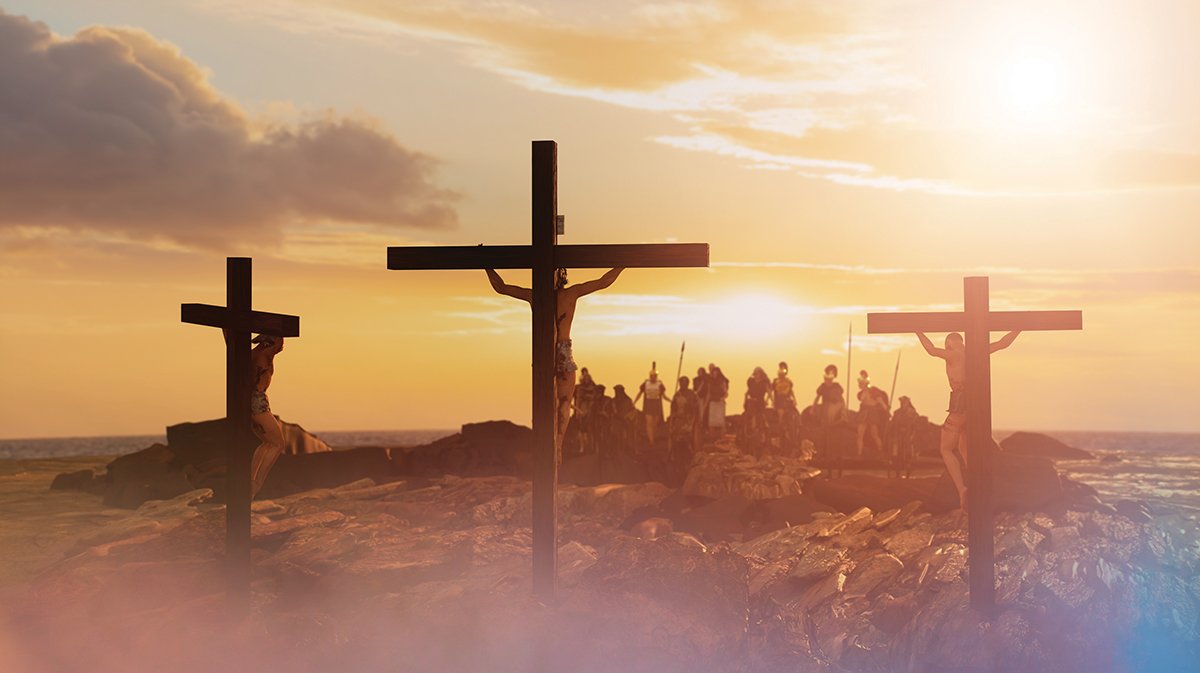
Exploring John’s unique testimony.
by R. Herbert
The Gospels of Matthew, Mark, and Luke all record the arrest, trial, and crucifixion of Jesus, and each gives its own details regarding these events. But the Gospel of John provides many unique insights into what occurred leading up to the death of Christ, with its whole second half (chapters 13-21) focusing on these things. This is because John was evidently the only disciple present at portions of Jesus’ trial (18:15-40) and was actually present at the foot of the cross (19:35).
Arrest
One of the most distinctive aspects of John’s Gospel is the long, detailed account of Jesus’ farewell discourse and prayer on the evening of His arrest. But John also gives us a distinctive fact regarding the arrest itself.
John alone tells us that when those sent to arrest Jesus found Him with His disciples in Gethsemane, they asked which one was Jesus. Most English translations say that when He answered, “I am he,” the soldiers and Jewish leaders fell backward in shock (18:6). But the English word he is added, and the words I am (ego eimi in Greek) directly echo the name of God that was revealed to Moses (Exodus 3:14).
These words Jesus spoke are the culmination of seven instances (John 4:26; 8:24, 28, 58; 13:19; 18:5, 8) in which Jesus used that exact phrase I am. (These are in addition to the seven statements John records in which Jesus affirmed such things as “I am the Bread of life,” etc.). I am is central to the primary theme of John’s Gospel regarding the divine nature of Jesus.
Trial
Because John’s family apparently had connections with the high priest, John could enter the high priest’s home (18:15) and apparently witnessed parts of Jesus’ trial. John exhibits a particular interest in recording Jesus’ important conversations with individuals (Nicodemus, the Samaritan woman, and others), rather than His public teaching of the crowds. So the apostle uniquely records Jesus’ discussions with the high priest and with the Roman governor, Pilate.
John also shows us an interesting and easily missed aspect of Jesus’ trial. The Synoptic Gospels tell us that Jesus was accused of many things (Matthew 27:13, 14; Mark 15:3, 4; Luke 23:14). But John tells us (18:29, 30) that when Pilate asked what charges were being brought against Jesus, the chief priests answered that He was a malefactor (KJV), an evil doer (ESV), or criminal (NIV). In legal charges, the Greek word used by John (kakopoios) frequently had the specific meaning of “magician” or “sorcerer.” Both the Jews and Romans had laws with severe penalties for doing works of magic or sorcery, and the religious authorities apparently used this as their initial accusation regarding Jesus’ miracles. When Pilate seemed to have pushed this initial charge aside, Jesus was then accused of something the Roman governor could not ignore.
King of the Jews
That one charge was treason — that Jesus was a leader in opposition to the authority of the emperor. John tells us more regarding this accusation than any other Gospel writer. He shows that when Pilate asked Jesus about His kingship, Jesus replied, “My kingdom is not of this world” (John 18:36), to which Pilate responded, “You are a king, then!” (v. 37).
Perhaps trying to placate the Jews’ anger, Pilate then allowed his soldiers to beat Jesus, to crown Him with thorns and cover Him in a purple robe symbolizing royalty (19:2, 3).
But although Pilate was evidently satisfied that Jesus posed no real threat to Rome (18:38), the Jewish leaders insisted “If you let this man go, you are no friend of Caesar. Anyone who claims to be a king opposes Caesar” (19:12). This, John tells us, was the pivotal point that led Pilate to allow Jesus to be crucified.
All the Gospels mention the sign Pilate affixed to Jesus’ cross, but John gives us the fullest wording of the sign (“Jesus of Nazareth, the King of the Jews”). Only he tells us that the sign was written in Hebrew (Aramaic), Latin, and Greek and that the Jews urged Pilate to change the wording, but he refused (vv. 20-22).
The cross
John’s presence at Jesus’ trial and condemnation meant that he was the only Gospel writer to record that Jesus bore His cross Himself at the beginning of the journey to Golgotha (19:17). It was only later that Simon of Cyrene was pressed into carrying the cross the final part of the way. And John’s presence at the foot of the cross also allowed him to be aware of a number of things that took place there.
One of them, John comments, is that, of all the disciples (in addition to him), only four women stood there: “Near the cross of Jesus stood his mother, his mother’s sister, Mary the wife of Clopas, and Mary Magdalene” (19:25). John also records the incredible love Jesus showed — despite the agony of His crucifixion — by instructing John to take His mother into his home to look after her (vv. 26, 27). In addition to some of the last words of Jesus not found in the other Gospels, John alone preserves Jesus’ great final cry of victory: “It is finished!” (v. 30).
John apparently stayed at the cross for some time after the death of Jesus, because he is the only one who tells us that the soldiers later broke the legs of the other two men crucified with Him, but not those of Jesus. Instead, John tells us “one of the soldiers pierced Jesus’ side with a spear” (v. 34) so that the scriptures would be fulfilled: “Not one of his bones will be broken” and “They will look on the one they have pierced” (vv. 36, 37).
Human and Divine
John fills his Gospel with unique details like those we have seen in this article. Nowhere is this clearer than in his extended narrative of the arrest, trial, and death of Jesus. Were it not for John, we would not have an actual eyewitness account of much of what occurred leading up to and at the cross. And we would see far less of both the humanity and divinity of Jesus’ supreme sacrifice.