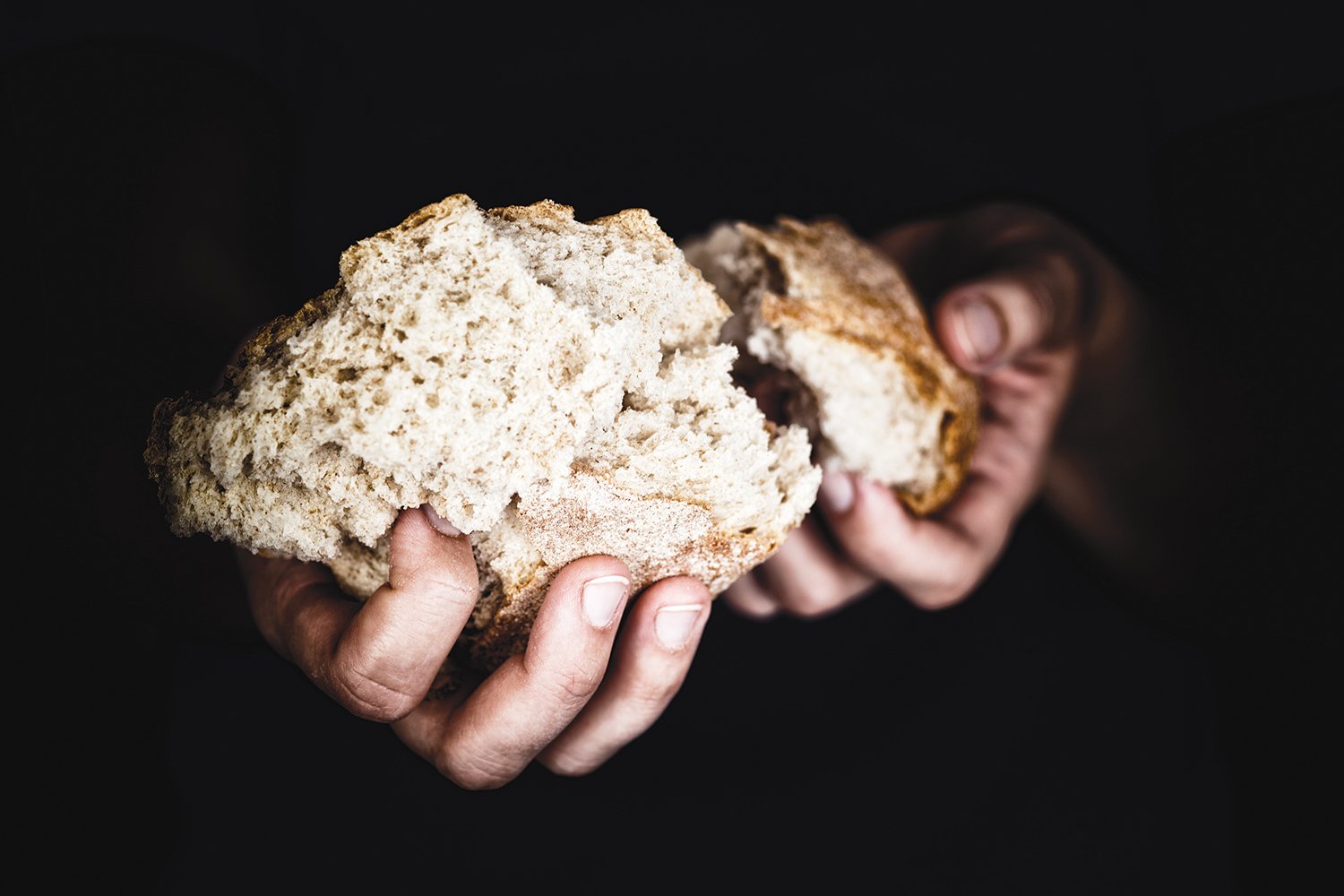
Big lessons from small leftovers.
by R. Herbert
All four Gospels feature Jesus’ miraculous feedings of great crowds: the four thousand in Matthew (15:32-39) and Mark (8:1-9) and the five thousand in Matthew (14:13-21), Mark (6:32-44), Luke (9:12-17), and John (6:1-14). All the accounts make it clear that after these meals, the disciples picked up large quantities of leftover crumbs, or small bits of bread and fish. The feeding of the five thousand in northern Galilee resulted in twelve baskets of leftovers, often seen as symbolic of the twelve tribes of Israel. The feeding of the four thousand in, or on the borders of, the Gentile region of Decapolis (see Mark 7:31) resulted in seven baskets of leftovers. This is often seen as symbolic of the seven people-groups of the Gentile area (Deuteronomy 7:1).
But the Gospel of John adds a key fact regarding these leftovers:
Jesus then took the loaves, and when he had given thanks, he distributed them to those who were seated. So also the fish, as much as they wanted. And when they had eaten their fill, he told his disciples, “Gather up the leftover fragments, that nothing may be lost” (6:11, 12, ESV; emphasis added).
Deeper meaning
In reading the story of this miracle, we tend to notice only the fact that after the feeding of the multitude, the disciples took up far more food than they started with. But notice that Christ’s instructions to gather up the remaining pieces of bread included the careful instruction “so that nothing may be lost” or, as we might say today, “Don’t lose any!” Clearly, there was no shortage of leftover food, so the command not to lose any of the crumbs had to have another reason.
To understand that reason, we must look closely at the Gospel of John. In the sixth chapter, John records the feeding of the five thousand as one of the key signs of Jesus’ messiahship and adds a great deal of context that is lacking in the other Gospels. After the feeding, John’s narrative proceeds with Jesus moving from the area, but what happens next is clearly connected. Once Jesus arrives at His destination, He begins to teach the people a lesson based on what they have seen a little while earlier.
Jesus said to them, “I am the bread of life; whoever comes to me shall not hunger, and whoever believes in me shall never thirst. . . . All that the Father gives me will come to me, and whoever comes to me I will never cast out. . . . And this is the will of him who sent me, that I should lose nothing of all that he has given me, but raise it up on the last day” (vv. 35, 37-39, ESV; emphasis added).
The disciples had doubtless not forgotten the feeding of the five thousand — or the work of picking up twelve baskets of leftover bits of food. So there is no doubt that they understood the connection between the miracle and the lesson Jesus taught, even if they did not comprehend its full significance at that time. Jesus was stressing to His listeners that the miracle was not only a sign of His messianic identity (v. 14) but also a living lesson revealing His and the Father’s intent in working with His human family (v. 39).
Bread of Heaven
While Jesus could have just verbally stressed, “Your Father in heaven is not willing that any of these little ones should perish” (Matthew 18:14), John shows how important the point apparently was — enough so that Jesus drove it home by means of a miracle. We may know intellectually that our Father does not desire that anyone be lost, but in our times of failure or discouragement, we should remember the extent to which Christ made that point for us to see clearly.
In many Bible translations, John 6:30 is rendered, “What sign will You give us?” This would be a strange question from the people after they just witnessed the feeding of the five thousand. But the Greek verb is not the future tense but in the present tense (“What is the sign You are giving us?”). The crowd was not asking for another sign but for an explanation of the one they had just seen (see KJV, ESV, NASB, etc.).
Quite rightly, the crowd interpreted Jesus’ feeding of the multitude in that wilderness area as a replication of the manna from heaven given in Moses’ time: “Our ancestors ate the manna in the wilderness; as it is written: ‘He gave them bread from heaven to eat’” (v. 31). By implication, if Jesus was like Moses, He must be the prophet that Moses had predicted to be like him (Deuteronomy 18:15). That was why the crowds desired to make Jesus their leader like Moses at that time (John 6:14, 15).
But Jesus turned the crowd’s attention from Moses to God: “It is not Moses who has given you the bread from heaven, but it is my Father who gives you the true bread from heaven” (v. 32). Jesus also emphasized another lesson: “Do not work for food that spoils” (v. 27). Instead, He told the crowds to work for the bread that God gives that endures to eternal life.
Work of faith
In saying this, Jesus taught us that salvation is work as well as a gift. We must work to receive the gift God offers us, and that work is the work of faith: “The work of God is this: to believe in the one he has sent” (v. 29).
Belief is one of the consistent themes of John’s Gospel. The apostle goes to lengths to emphasize that, while Jesus offered those who come to Him eternal life, we must believe in Him as the true Bread of Life to receive that gift.
And when we do believe, and endure in our belief, we ourselves become part of another miracle. Spiritually, we become one with the Bread of Life and, at the same time, separate fragments of Him. Like the crumbs in the miraculous signs Jesus performed, it is His will that none of us should be lost.