Finding the right balance as citizens of two kingdoms.
by Tez Brooks
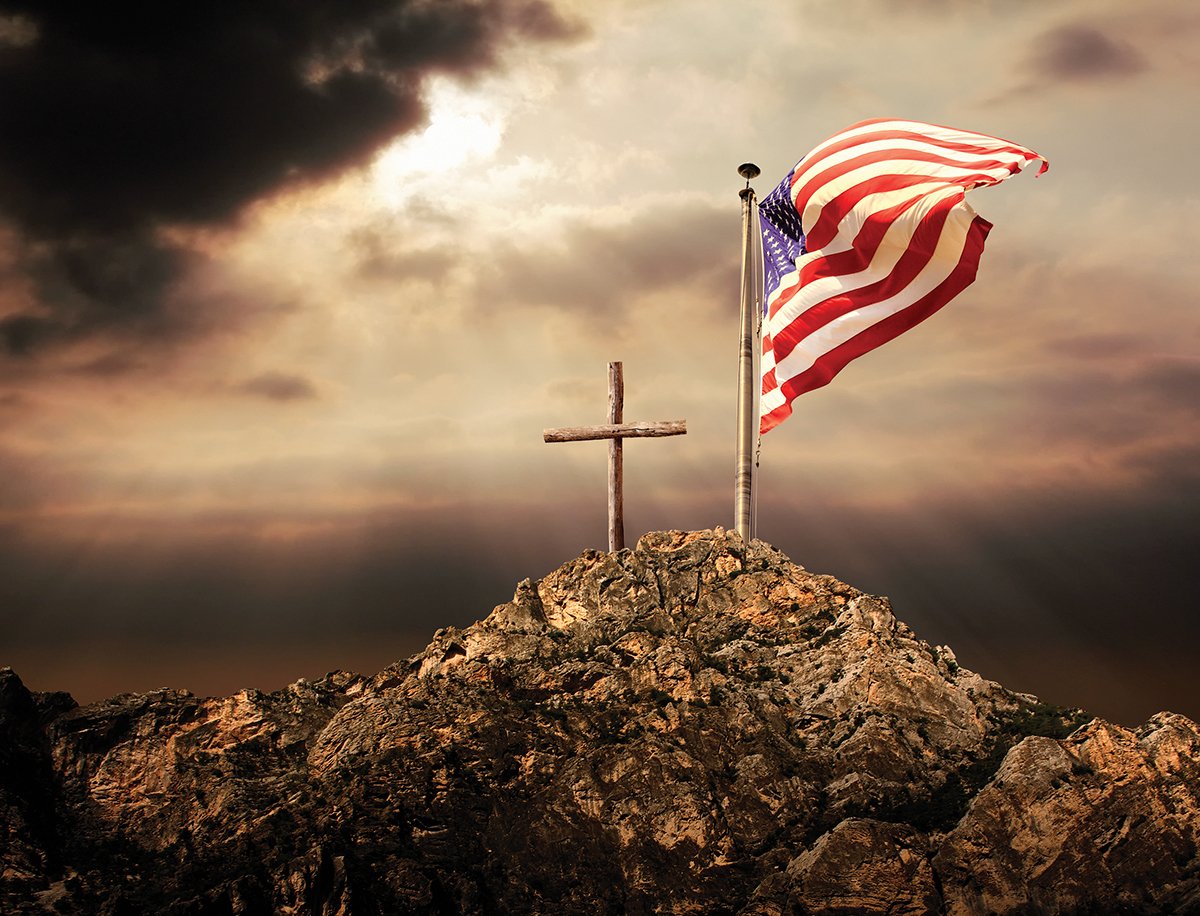
Christians often champion two causes: following the Carpenter with a cross and cheering the candidate with a crown. But what if building God’s kingdom through politics becomes the thing that keeps us from it?
The phrase Christian nationalist is thrown around a lot. Do we understand it? Living in a Christian nation sounds ideal, but is it? Perhaps the bold belief for God’s kingdom isn’t fought at the polls but in the human heart.
Lately I have pondered that if Jesus left His throne to become a fragile, ordinary man, then humility isn’t just something He asks of us; He modeled it.
Consider this: The Creator of galaxies wrapped Himself in skin, walked dusty roads, and ate meals with fishermen. That means our calling isn’t to climb higher but to bow lower. Our hope is Jesus, nothing else.
Am I suggesting that embracing adversity means we should cower and tolerate mistreatment? No, we should stand for what’s right, even in the face of persecution. What outspoken Christians do is inspiring to me and millions of others. But there is a big difference between a nationalist and a Christian nationalist.
What does it mean?
Nationalism is an ideology centered on patriotism and loyalty, but Christian nationalism is a specific form of religious dominance that advocates fusing Christian and national identities. A key difference is the role of religion: While a nationalist merely loves his country, a Christian nationalist believes the nation should be defined by and be governed according to religious principles, much like many Islamic leaders.
While this might sound nice for us believers, we must understand that Christ’s kingdom doesn’t come through voting or military victories. It doesn’t grow by legislating morality or seizing political office. In fact, Jesus told His disciples the opposite: The greatest in His kingdom will be the servant of all. He flipped the script. The first will be last, the last will be first.
So we should pause when we hear teachings about Christian dominionism — to establish God’s rule on earth. It may sound bold, even patriotic. But Scripture instructs being salt and light to influence. The Bible consistently shows us that Jesus initiated His kingdom and said it’s like a mustard seed that grows. Christ will complete His kingdom at His second coming.
Until then, we are living in the now and the not yet, meaning the kingdom is already here in our hearts (Luke 17:20, 21), not a physical territory. But it can’t be finalized until Christ comes to reign. Until then, we are to serve, not dominate.
Can we vote against ungodly laws? Of course, and we should. We are not meant to passively embrace every pagan legislation in the name of love and acceptance. But we also don’t want to create a nation that fines or imprisons those who don’t obey God — that’s what some Middle Eastern nations do. It’s about a heart change (being born again), not Christian nationalism.
Without the gospel and salvation, we are merely asking the nation to mimic the children of God rather than become children of God. When we replace heart transformation with demands for morality, we undermine the gospel. It’s a foreign gospel. No one is getting saved; they are just forced to comply.
Not of this world
Pilate once asked Jesus if He was a king. If there was ever a moment for Jesus to rally His followers and declare an earthly revolution, this was it. Instead, He answered, “My kingdom is not of this world. If My kingdom were of this world, My servants would fight . . . but now My kingdom is not from here” (John 18:36).
When the Pharisees asked Him when this kingdom would come, Jesus replied, “The kingdom of God does not come with observation; nor will they say, ‘See here!’ or ‘See there!’ For indeed, the kingdom of God is within you” (Luke 17:20, 21).
These verses dismantle the domineering dream of ushering in God’s reign on earth through policies or political systems that point to us rather than to Christ. If Jesus wanted His followers to seize control, He would have said so then. Instead, He pointed away from earthly kingdoms and toward a spiritual one. You can’t map it on a globe. You can’t point to a Capitol building and say, “There it is.” The kingdom is spiritual; it begins in the hearts of believers.
In the Old Testament, Israel was a theocracy ruled directly by God. But when Jesus came, everything shifted. Under the new covenant, believers live under earthly governments. Paul told the church in Rome, “Let every soul be subject to the governing authorities. For there is no authority except from God”
(Romans 13:1).
Keep in mind Paul wrote this under Nero, a violent persecutor of Christians. Yet he never told believers to overthrow the empire. His counsel was to respect leaders unless they directly opposed God’s commands. That’s when we can stand up and refuse to comply. That’s an individual act we are to do, to show our devotion to God’s precepts.
We are to fear God more than human authorities, and if this leads to a quiet and peaceful disobedience, so be it. But be prepared to accept the consequences of your disobedience and suffer in the name of Christ. Yes, we do need to get godly leaders into places of high authority, not to create a bubble of moral uprightness but to be a light to the world that points to Jesus as the answer.
What Jesus commanded
Before ascending to heaven, Jesus made His mission clear: “Go therefore and make disciples of all the nations, baptizing them in the name of the Father and of the Son and of the Holy Spirit, teaching them to observe all things that I have commanded you; and lo, I am with you always, even to the end of the age” (Matthew 28:19, 20).
In full-time ministry for the past twenty-four years, I’m reminded daily that our mission is disciple-making, not empire-building. Paul echoed this when he urged Timothy, “Preach the word! Be ready in season and out of season. Convince, rebuke, exhort, with all longsuffering and teaching” (2 Timothy 4:2). Notice the verbs: preach, teach, baptize, love, serve.
You won’t find seize power anywhere in Jesus’ commands. When asked about paying taxes, Jesus answered, “Render to Caesar the things that are Caesar’s, and to God the things that are God’s” (Mark 12:17). This was a dividing line. Governments belong to this world, but God’s kingdom is eternal.
I try to live this out well by paying my taxes and respecting the law, but my hope isn’t in Washington DC, nor is it in my ministry efforts. It’s in Christ. I’m a citizen of two kingdoms, but I know which one is more important and eternal.
Dangers to avoid
Christian nationalism is seductive because it promises security, power, and influence. But it reduces the gospel to a political ideology. While it is a noble cause, it implies that faith is only real if it dominates. It is salvation by another means than Christ.
A fellow believer once confessed to me that he felt hopeless because his candidate lost an election. He said, “I just don’t see how Christianity can survive now.” That concerned me because the gospel has thrived under emperors, dictators, monarchies, democracies — every government system imaginable. But Christians are still around today — even after several attempts of mass genocide. That’s because Jesus doesn’t need a president or a king to validate His kingdom. He already reigns.
The early church had no voting rights, no lobbyists, no political parties. Yet their influence transformed the Roman Empire with radical love. The Old Testament also records kindness from God’s people when cruelty was the norm. Love your neighbor. Pray with a co-worker. Forgive those who wrong you. Your quiet faithfulness speaks louder than any political rally.
Citizens of two worlds
Paul says, “Our citizenship is in heaven” (Philippians 3:20). We still vote, pay taxes, and pray for leaders, but our ultimate allegiance is to Christ.
I think of some of the schoolteachers I know. They don’t always agree with district policies, but they view the classroom as their mission field. They pray over the students’ desks before they arrive. These teachers offer encouragement and model Christ’s love. Their influence doesn’t come from power — it comes from God’s presence in their lives.
Christian dominion isn’t biblical. The gospel doesn’t need government endorsement or power to thrive. The teachings of Jesus point us to humility, servanthood, and spiritual transformation. So if your ministry is in the limelight, use it! Count the cost, but don’t stop, don’t cower (even if it means certain death). People desperately need a Savior, and you know the only solution. Proclaim it boldly!
My prayer is “Lord, help us remember Your kingdom is not of this world. Forgive us if we have placed too much hope in human leaders, trying to create heaven on earth. Teach us to trust that Your return will set all things right. We humans cannot.”
Ballots, presidents, or armies will not bring the kingdom of God. It will come when Christ returns in glory. Our calling is clear: Live humbly, love deeply, and share the good news boldly while crying, “Come, Lord Jesus. Our only hope!”