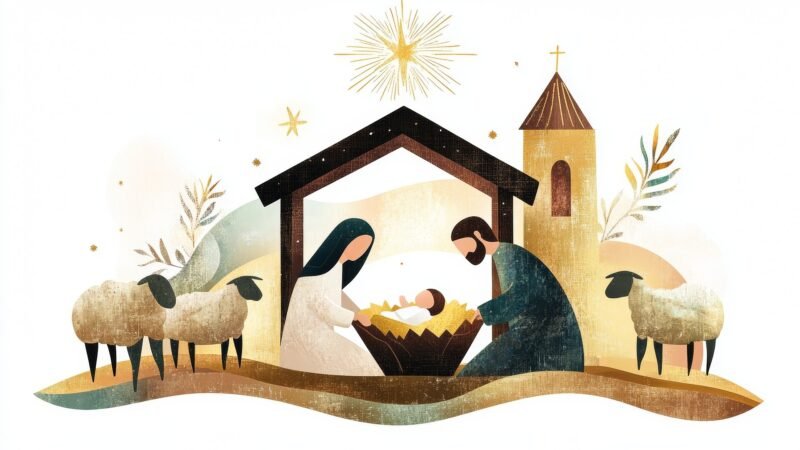

Marveling at the humble origins of salvation.
by Ruhama Tewodros Assefa
The way we are saved and given new life in Christ is truly astonishing. Often, our focus is on Jesus’ crucifixion — His sacrificial death — and His glorious resurrection. These are indeed the foundation of our faith.
Yet the wonder of Jesus does not begin at the cross or the empty tomb. His entire story — from His divine parentage and miraculous birth to His quiet years in Nazareth, suffering, resurrection, and future glory — reveals a mystery beyond human understanding. He is the Son of the Highest, and His life fulfills a divine mission planned long before the New Testament.
This mission stretches back into the Old Testament, woven through prophecies spoken by people who sometimes understood what they were saying and sometimes did not. God spoke through prophets who anticipated a coming Savior, and He spoke through ordinary lives that foreshadowed Christ. Some prophecies, like Isaiah’s prediction of the Virgin Birth, were clear. Others, embedded in historical events, only later revealed their greater meaning. In His perfect wisdom, God shaped these prophecies to prepare the world for His Son.
Divine mission
During a recent Bible study, this truth struck me. As I read John 17:12, I became curious about the prophecy Jesus mentioned. Following the references, I landed on Psalm 41:9 and Zechariah 11:12, 13.
Psalm 41:9 was originally David’s heartfelt lament over betrayal by his trusted adviser, Ahithophel, during Absalom’s rebellion. Yet through the Holy Spirit, David’s words also pointed forward to a greater betrayal: Jesus’ own, by Judas.
Jesus’ birth and death, and even His betrayal, were part of God’s divine mission. This is an example of dual fulfillment, or typology, where a real event in the Old Testament foreshadows a much greater reality in Christ’s life.
If even Jesus’ betrayal was foretold, how much more His birth and early life? These were no accidents but essential parts of God’s salvation plan.
Son of God and Man
Many people today question how Jesus can be both man and God. They debate, doubt, and try to fit Him into human logic. But the truth is that Jesus did not enter the world the same way we did. He was conceived by the Holy Spirit and formed in the womb of a virgin — a miracle that also stands at the foundation of our faith.
The story begins when the angel Gabriel appeared to a young woman named Mary (Luke 1:26-35). Mary was an ordinary girl living in an ordinary town, yet heaven visited her with an extraordinary message: She would conceive a Son. Gabriel declared, “He will be great, and will be called the Son of the Highest.”
These words reveal everything. Jesus’ identity was not rooted in human lineage but in divine origin. He did not begin at conception; He simply took on flesh.
Mary’s virginity was not just a detail in the story of Christ’s birth. It was the fulfillment of Isaiah 7:14, the ancient prophecy that said a virgin would bear a Son who would be called Immanuel, meaning “God with us.” Mary’s womb became the holy place where God’s plan entered human history.
Though not the biological father, Joseph played a vital role in the story as well. In Matthew 1:18-25, an angel instructed him to take Mary as his wife and to name the child Jesus. Joseph was chosen to protect and guide the holy Child, to raise Him with honor, and to stand as the earthly guardian of the One who came from heaven.
This is the mystery of Jesus: He is the Son of God and the Son of Man at the same time. He was born of a woman, as Galatians 4:4 says, yet conceived by the Holy Spirit. He grew up in a human family, yet His Father was the Lord of heaven. Divinity clothed itself with humanity, not through power but through humility.
The beauty of this truth is that God did not enter the world with royal ceremony. He came quietly, gently, and humbly, showing us that His greatest works often begin in the simplest places.
Extraordinary and ordinary
Jesus’ birth took place in Bethlehem, a small, humble town chosen by God for a divine purpose. The prophet Micah foretold this centuries before: “But you, Bethlehem . . . out of you shall come forth to Me the One to be Ruler in Israel” (Micah 5:2). It was here that heaven’s King made His entrance — not with grandeur or fanfare but in a lowly stable.
The contrast between Jesus’ divine status and His birthplace could not be greater. The King of Kings was born among animals, laid in a manger because there was no room in the inn. This ordinary beginning reveals a profound truth: God did not come to rule through earthly power or wealth but through humility and love.
The night of Jesus’ birth was marked by a heavenly announcement to simple shepherds. Luke 2:8-14 tells us that an angel appeared, and suddenly the sky was filled with the glory of the Lord. The hosts of angels proclaimed, “Glory to God in the highest, and on earth peace, goodwill toward men!” The shepherds’ fear turned to joy, and they rushed to see the newborn Savior.
Later, wise men — Gentiles — from distant lands came to worship Jesus, bringing gifts and recognizing Him as King (Matthew 2:1-12). Their visit shows that Jesus’ birth was not only for Israel but for all nations. God broke down barriers: Divine met human, rich met poor, Jew met Gentile.
This event teaches us that even the most ordinary places and people can be the setting for God’s greatest purposes. The manger scene challenges us to see God’s glory not in wealth or status, but in simplicity and surrender. Jesus’ birth reminds us that God’s kingdom often starts quietly, in hidden places, and grows in ways the world does not expect. It encourages us to trust that even in humble beginnings, God is at work, fulfilling His divine plan for salvation and hope.
Growing in wisdom and favor
After His birth, Jesus’ early years were marked by both protection and growth, fulfilling prophecies even in His infancy. Soon after the Magi’s visit, an angel warned Joseph in a dream to flee to Egypt with Mary and Jesus to escape King Herod’s deadly plan (Matthew 2:13-15). This journey, though dangerous and difficult, fulfilled what the prophets had spoken: “Out of Egypt I called My son” (Hosea 11:1). Even when Jesus was a baby, His life was intertwined with God’s plan, showing that His mission was carefully guided from the very start.
After returning from Egypt, Jesus grew up quietly in Nazareth, a small town often overlooked by the world. Luke 2:40 tells us that Jesus “grew and became strong in spirit, filled with wisdom; and the grace of God was upon Him.” These hidden years were crucial. During this time, Jesus learned obedience, grew in knowledge, and prepared for His public ministry.
One of the few glimpses we have into Jesus’ youth is the story of Him at age twelve in the temple courts, sitting among the teachers, listening to them and asking questions (vv. 41-52). When His parents found Jesus after three days of searching, He said, “Did you not know that I must be about My Father’s business?”
These words reveal Jesus’ awareness of His divine mission even as a boy. Though fully God, He experienced human growth and understanding, showing the perfect balance of divinity and humanity.
Despite His unique identity, Jesus submitted to His earthly parents, returning with them to Nazareth and living under their care. Even the Son of God valued family, respect, and patience in the hidden seasons of life.
God’s timing is perfect. Jesus did not rush into His mission but grew through ordinary human experiences, learning, obeying, and waiting for the appointed time. He shows us that growth often happens in quiet moments, away from the spotlight.
As we reflect on Jesus’ youth, we see the pattern of humility and preparation that shapes every believer’s journey. God calls us to grow in wisdom and favor, trusting Him as He prepares us for the purpose He has planned.
Hope and strength
As humans, we face many challenges and struggles. Words often fail to express the depth of our feelings. Yet there is one comforting truth: Jesus understands it all.
Except for sin, He has experienced everything we go through. He was one of us — fully human — and so He knows our pain, our sorrow, and our every burden. Because of this, we can find hope and strength, knowing we are never alone in our journey.